Thursday, June 3, 2010

PAKISTAN: Lake Disaster Triggers New Displacements

Up until Saturday the Attabad Lake in northern Pakistan had been rising one meter every day and was thus on the verge of breaking its banks, observed Lieutenant General Nadeem Ahmed, chairman of the National Disaster Management Authority (NDMA). In the last four months, the water level had been rising in the lake due to glacial melting, swelling it to 18.5 kilometers long and 107 meters deep, he explained.


Then what he had feared all along happened over the weekend when the Attabad Lake in the Hunza Valley in northern Pakistan broke its banks, which were over-topped with water flowing into the spillway.

The water pressure is low but the artificial lake could burst in the next 12 hours, resulting in massive floods in the region, said Ahmed. If that happens, he said, another major disaster could be in the offing.

On Jan. 4, following a snowstorm, a massive landslide hit the village of Attabad, in Pakistan-controlled Gilgit-Baltistan (G-B), an autonomous territory in the northern part of the South Asian country with an estimated population of one million. Initially, it forced some 1,200 people to evacuate their homes. The resulting debris blocked Hunza River, creating a lake now known as Attabad Lake.

As the lake swelled, another village, Sarat, was also submerged while two others were inundated by floodwaters.

"As a result of the formation of the lake, four bridges that linked 16 villages upstream and the 22-kilometer Karakoram Highway linking Pakistan to China have been submerged in water," said Asif Hussain, spokesperson of the Pakistan Red Crescent Society (PRCS) in G-B.

With another disaster looming and to preempt a "worst case scenario" – a lake outburst flooding – the NDMA had as of May 24 evacuated close to 17,000 people from 34 villages downstream, including Attabad and Sarat villages, and along the spillway to safer locations, said Brigadier Sajid Naeem, NDMA's spokesperson, in a phone interview with IPS from Islamabad, the capital of Pakistan.

"This has been done to avert human casualty (and) as a precautionary measure in case breaches are created in the hurriedly dug up 450 meter-long drainage channel and it (the spillway) collapses," said Naeem.

Landslides and flash floods are a seasonal occurrence in the G-B region, which is surrounded by the Himalayas and the Hindu Kush and Karakoram mountain ranges.

Simi Kamal, a geographer and a water expert, said while the direct cause of the lake disaster was a landslide that blocked the water's path, the impact of climate change, which are believed to have triggered extreme weather conditions, could not be ruled out.

"Indirectly, it is linked to climate change, because the whole water balance and ecology of the Himalayan region is changing, causing instability," she pointed out.

A United Nations-backed report released in December 2009 said climate change was posing serious threats – one of which is catastrophic flooding – to the Hindu Kush-Himalayan region. The report was the result of a two-year pilot assessment jointly conducted by the U.N. Environment Program, the Center for International Climate and Environmental Research and the International Center for Integrated Mountain Development.

The PRCS, an affiliate of the International Federation of Red Cross and Red Crescent Societies, is assisting the NDMA in the construction and management of camps for internally displaced persons (IDPs) in schools and health centers around the mountainous Hunza Valley in G-B.

Gulfam Jaffar, 23, and her family of six have been living in a primary school- turned relief camp in Altit village in Hunza Valley since Jan. 6, two days after water flooded their village near Attabad, killing 19 of her kin.

According to Jaffar each classroom has between four to five families. "It's very crowded," she said.

Five months since they lost everything and ran to safety "with nothing but the clothes on our backs," Jaffar, a village schoolteacher, sees little hope of returning to her village soon. "My village is now many feet under water," she said desolately.

Unlike Jaffar, some 800 residents of Rahimabad village near Attabad, who have been displaced by the landslide, have had to move into tents set up by the PRCS because of the limited space in public evacuation centers.

"Arrangements have also been made to ensure provision of relief goods to the 16 villages with a population of about 25,000 that have been cut off from the rest of Gilgit-Baltistan due to the lake," said Naeem.

With all roads closed, bridges submerged, the only way to extend assistance to the IDPs is through helicopters, he said. The NDMA has deployed seven helicopters in Gilgit to transport people and goods.

The United Nations Children Fund said it had already sent 750 sanitation facilities to the IDP camps and pledged a continuous supply of potable water supply for up to 30,000 persons.

In anticipation of catastrophic flooding and widespread displacement of the affected villages in the event of a lake burst, the NDMA has set up at least 31 more IPD camps in two of the seven districts of the Gilgit-Baltistan region.

Source:
Reuters AlertNet, "PAKISTAN: Lake Disaster Triggers New Displacements", accessed June 1, 2010

Wednesday, June 2, 2010

Metaio presents: next generation augmented reality browsing


Karlsons klister ... Lim rumlig information fast til den virkelige verden ...
/Sik


Augmented Reality is (also) the process of gluing spatial information til real live objects ...
/Sik

Quote
Metaio`s exciting new "augmented reality" browser junaio® has extended its capabilities beyond the usual location based internet services. Not only may the user obtain information on nearby POIs such as shops, restaurants or train stations, but the camera`s eye is now able to identify objects and "glue" object specific real-time, dynamic, social and 3D information onto the object itself. This unique feature is now being extended through collaboration with kooaba and its visual object search capability, providing access to kooaba`s extensive object databases. Initially available on Android, an iPhone release will follow soon.


Read more: http://www.youtube.com/watch?v=Tz-lYtzKpTo

Take a test drive into the cloud


Skyhøje priser eller tågedis over landet ... ?
/Sik


Buy a small piece of the Internet ... Go Google ...
/Sik

Quote
We’ve talked about the power of cloud computing and how millions of businesses have alreadygone Google by switching to Apps. But sometimes it’s hard to imagine what working in the cloud would really mean, and frequently, people ask us how they can better understand the benefits of Google Apps specifically for their business. How would online collaboration really affect your workplace? And how could increased email storage or integrated IM and video chat actually impact your company’s productivity?

To answer some of these questions, we’ve created the Go Google cloud calculator to let you take a test drive into the cloud. Whether your company is big or small, brand new or been around for a while, this tool will give you a sense of the benefits of going Google in an easy-to-understand way. Here’s a quick demo:


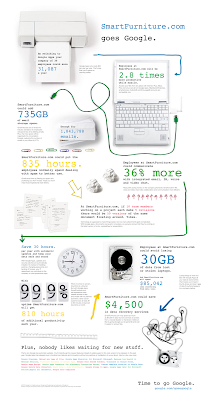
Once you take a spin and learn about the potential cost and time savings, the tool will create a custom URL, presentation PDF, spreadsheet or even a poster that you can share with other decision makers within your business as you discuss going Google.

To show you a real-life example, we asked one our customers, Smart Furniture (you may remember them from their recent guest post), to test-drive the tool for us. And here’s their poster:


So if you’ve been thinking about moving your business to the cloud, take a couple minutes and see what it would be like to go Google. Be sure to tweet and share your results. The Go Google cloud calculator can be found at www.gonegoogle.com.


Read more: http://googleblog.blogspot.com/2010/06/take-test-drive-into-cloud.html

Europe in bloom: a living façade at the European Environment Agency


Et levende kort ...
/Sik


Living map ...
/Sik

Quote
The Living Façade is one of EEA's main contributions to the United Nations International Year of Biodiversity. The front of our building on Kongens Nytorv 6 is covered with about 5,000 annual plants showing a map of Europe and plant biodiversity. The façade will stay in place from 22 May to October 2010. Follow the project step by step, and learn more about the science behind it.


Read more: http://www.eea.europa.eu/themes/biodiversity/living-facade

Cameras to monitor melting Everest

Five special time-lapse cameras have been installed for the first time in the Mount Everest region to monitor the melting of the glaciers. The cameras were installed last week by the technical team of an organization -Extreme Ice Survey - a world-renowned American organization.

Confirming the installation of cameras, an EIS source said, “Our technicians have just returned to USA after the successful installation of five cameras to monitor the melting of the glaciers.”According to EIS,
four cameras will monitor the Khumbu Glacier (right) and one Nare Glacier on the south side of Ama Dablam.

EIS is the most wide-ranging glacier study ever conducted using ground-based, real-time photography that uses time-lapse photography, conventional photography and video to document the rapid changes occurring on the earth’s glacial ice. EIS has already installed 27 time-lapse cameras at 15 sites in Greenland, Iceland, Alaska, and the Rocky Mountains.

Cameras in the Everest region were installed to provide ground information on the melting of the Himalayas that had become a
controversial issue after an error in the key document of the Intergovernmental Panel on Climate Change - a scientific body to look into climate change issues. IPCC recently admitted data mistake in its report published in 2007 about the disappearance of all the glaciers in the Himalayas by 2035.

Issuing a statement, the head of the IPCC Rajendra Pachauri had admitted that the date was a mistake but had claimed that ice is melting at a rate faster than ever in the Himalayas and pointed out the need of
rigorous studies.

According to mountaineer Dawa Stevan Sherpa, who was involved in the installation, the team will monitor the images that will be automatically captured every 30 minutes for two years. “There has been a dispute on the melting of the glaciers. Continuous monitoring of the images for two years will yield the most comprehensive evidence to settle the dispute,” said Prashant Singh, World Wildlife Fund-Nepal’s Climate Change Campaign chief.

The cameras powered by the solar panels and batteries were mounted on
vertical rock faces. The captured photos are automatically stored in the cameras and the technicians will check the cameras and download them for analysis every six months.

“The compiled and analyzed imagery will be disseminated across the world to silence the climate change skeptics,” said Dawa Stevan.

Source:
The Himalayan Times, "Cameras to monitor melting Everest", accessed June 1, 2010

Tuesday, June 1, 2010

Amygdala Vegetariana


In Short Cuts, the "vegetarians and vegans are more empathetic" neuroimaging article was mentioned in passing, but I didn't actually blog about it. However, there has been one thing [OK, more than one thing] bothering me about this paper...

But first, a quick summary of the Methods which were rather straightforward.

Filippi and colleagues (2010) recruited 20 omnivores, 19 vegetarians, and 20 vegans to participate in a study that examined their brain responses to images of human and animal suffering. They were naïve as to the goals of the experiment. Before entering the scanner, all participants completed the Empathy Quotient, a 40 item questionnaire [plus 20 filler questions] that rates one's level of empathy (Baron-Cohen & Wheelwright, 2004). The omnivores did indeed have lower EQ scores (38.8) than the vegetarians (49.5) and the vegans (44.6), who did not differ from each other.

The fMRI experiment used an...
...event-related design during observation of negative affective pictures of human beings and animals (showing mutilations, murdered people, human/animal threat, tortures, wounds, etc.). Participants saw negative-valence scenes related to humans and animals, alternating with natural landscapes.
So what were the neuroimaging findings? To no one's surprise, results indicated differences between the groups, as shown below.


Figure 3. Results of the between-group comparisons of emotional (human and animal) negative valence picture views. Results are superimposed on a high resolution T1-weighted image in the standard MNI space, at a threshold of p less than 0.05 corrected for multiple comparisons. Areas activated during human picture view in vegetarians and vegans vs. omnivores are shown in yellow. Activations specific for vegetarians are shown in blue. Activations specific for vegans are shown in red. A: human picture view; B: animal picture view. [NOTE: I've labeled the corpus callosum.]

Also to no one's surprise, differences between the groups were more pronounced for animal pictures (Fig. 3B) than for human pictures (Fig. 3A).

Some of the results were interpreted in Rorschach inkblot fashion: the authors saw want they wanted to see in them. Since when are the specific regions of the anterior cingulate cortex (ACC) and the inferior frontal gyrus (IFG) shown above primarily known as "empathy-related regions"? They're not.1
...vegetarians and vegans have constantly an higher engagement of empathy related areas while observing negative scenes, independently of the species of the individuals involved, which is characterized by an increased recruitment of the ACC and the IFG. Increased activation in the ACC and left IFG in vegetarians and vegans during human and animal suffering view is likely to reflect a stronger empathic response in the first two groups.
Curiously enough, the amygdala (a limbic structure important for emotion) was not activated by animal suffering in either the vegetarians or the vegans. Although the amygdala (LeDoux, 2007) is predominantly known for its role in fear conditioning, it is also activated by other emotional responses including disgust (e.g., Kober et al., 2008).
Remarkably, the within-group analysis during animal picture view, showed the absence of signal changes (in terms of activations and deactivations) within the amygdala in vegetarians and vegans, suggesting a down-regulation of amygdala response from areas located in the frontal lobes, in an attempt to regulate emotion through cortical processes in these subjects.
Why would the vegetarians and vegans attempt to down-regulate their emotional responses to animal suffering? And why would the vegans show greater amygdala responses to human suffering than did the omnivores and vegetarians??


Figure 4. Interactions between stimuli (animal/human) and groups (omnivore/vegetarian/vegan). (A) An interaction was found in the right amygdala, indicating greater increase to animal negative valence picture view in omnivores and to human negative valence picture view in vegans. An interaction between “human pictures” and “vegan group” was also found in the left amygdala.

Previously, NeuroKüz mentioned some objections to the study design in a post on The empathetic vegetarian brain.2 I won't detail his critique here other than to summarize:
  • The control condition consisted of “neutral” scenes that did not include living beings, faces, or suffering of any kind.
  • Participants passively viewed the photos, they did not have to respond by indicating their emotional reactions.
  • Participants could be desensitized to human suffering by watching the news.
One of the greatest issues, in my view, is with the mode of stimulus presentation. The event-related design (which is usually preferable) may not have allowed adequate time between pictures to "recover" from the shock of seeing a mutilated human or animal. If this were especially true for vegetarians and vegans viewing images of animal suffering, it could explain the curious silence of the amygdala. In such scenario, a blocked design (presenting all stimuli of one category in blocks, rather than intermixed) might have been a better idea.

The vegetarians and vegans in this study all made their dietary choices for ethical reasons. It is quite conceivable that they differed from the omnivores on any number of other dimensions. For example, evolutionary psychology extremist Satoshi Kanazawa recently blogged about Why Vegetarians Are More Intelligent than Meat Eaters, but this only held for a UK sample born in 1958, but not for a US sample born between 1974 and 1983. In addition, some militant vegan PETA-types condone violence against scientists performing animal experiments, so one could expect their responses (and empathy) towards human suffering to be diminished [NOTE: empathy scores were numerically lower for vegans than for vegetarians].

It would be interesting, then, to compare these "ethical" sorts to others who have chosen to be vegetarian or vegan for heath reasons, such as familial hypercholesterolemia or athletic competitions such as the triathlon.


Left: Ma Po Tofu with Steamed Broccolini

Footnotes

1 Compare anterior cingulate cortex, empathy to anterior cingulate cortex, cognitive control.

2 Here's an even newer post, Empathy is What Really Sets Vegetarians Apart (at least Neurologically Speaking).

References

Baron-Cohen S, Wheelwright S. (2004). The empathy quotient: an investigation of adults with Asperger syndrome or high functioning autism, and normal sex differences. J Autism Dev Disord. 34:163-75.

Filippi, M., Riccitelli, G., Falini, A., Di Salle, F., Vuilleumier, P., Comi, G., & Rocca, M. (2010). The Brain Functional Networks Associated to Human and Animal Suffering Differ among Omnivores, Vegetarians and Vegans PLoS ONE, 5 (5) DOI: 10.1371/journal.pone.0010847

Kober H, Barrett LF, Joseph J, Bliss-Moreau E, Lindquist K, Wager TD. (2008). Functional grouping and cortical-subcortical interactions in emotion: a meta-analysis of neuroimaging studies. Neuroimage 42:998-1031.

LeDoux J. (2007). The amygdala. Current Biology 17: R868-R874.

Stolen from here.

Lawmaker disputes BP's claims about underwater oil

Rep. Edward Markey on Monday challenged the assertion by oil giant BP's chief executive that no underwater oil plumes have formed because of the Gulf of Mexico spill.

Markey, D-Massachusetts, said in a letter to BP that scientific evidence showed such plumes have formed, and he asked for BP CEO Tony Hayward to provide evidence to back up Hayward's claim Sunday that the oil had gone to the surface.

On Sunday, Markey, who heads the House Energy and Environment subcommittee, accused BP of issuing false statements about the spill.

"BP in this instance means 'Blind to Plumes,' " Markey said in a statement Monday.

There was no immediate response from BP.

Meanwhile, the federal government ordered another 1,200 square miles of the Gulf waters closed to fishing Monday because the oil spill off Louisiana, extending the restricted zone toward the coasts of Alabama and Mississippi.


The latest order from the National Oceanographic and Atmospheric Administration means about 26 percent of the Gulf is closed to fishing, up only slightly from 25 percent last week. But it comes on the eve of the opening of the recreational fishing season for red snapper, a strong draw for sport fishing in the region.


According to the NOAA, the closed area now represents 45,728 square miles, which is slightly less than 19 percent of Gulf of Mexico federal waters. This leaves more than 81 percent of Gulf federal waters—or nearly 195,000 square miles—still available for fishing. The newly closed area is more than 150 miles from the nearest port and primarily in deep water used by pelagic long-line fisheries that target highly migratory species, such as tuna and swordfish. Coastal fisheries, such as grouper, snapper and shrimp, will not be affected by the expansion of the closed area.

The closure extends from north of Louisiana's Chandeleur Islands, east along the three-mile offshore border between federal waters and Alabama and Mississippi state waters to just west of Gulf Shores, Alabama. It follows NOAA forecasts that showed oil from the massive Deepwater Horizon spill spreading toward those states' coasts later this week.

"Closing fishing in these areas is a precautionary measure to ensure that seafood from the Gulf will remain safe for consumers," NOAA said in a statement announcing the decision.

The move is likely to be another blow to an already beleaguered fishing industry, which brings in billions of dollars to the Gulf states. Early studies have estimated the economic damage from the spill could run as high as $1.6 billion.

The closure took effect at 6 p.m. Monday in federal waters.

Markey's letter to BP said "the confirmation of the presence of large quantities of oil sub-surface could help to inform clean-up and response efforts, and it is vital that there is unfettered access to all relevant data or analysis."

The letter noted that University of South Florida researchers recently reported finding a 22-mile-long plume of dispersed oil.


In a separate letter Monday to BP, Markey called for complete transparency regarding video feeds of the company's underwater operations. BP is launching an effort to cut an opening to the leaking equipment so that a containment dome can be lowered on it.

"There cannot be any delay or gaps in our understanding of this situation, given that thousands of barrels of oil are spewing forth each day into the Gulf, with catastrophic long-term consequences," said Markey's letter to BP America head Lamar McKay, adding: "BP should not be controlling the view the American public has of this disaster in our ocean."


As the oil spill entered its 42nd day Monday, efforts to clean up coastal areas and develop a new plan of attack continued.

BP could try to cap a massive oil gusher again this week in an attempt to solve what the Obama administration has called "probably the biggest environmental disaster we've ever faced in this country."

All attempts at containing the crude gushing from BP's undersea well have failed, including a "top kill" approach on which many had pinned their hopes.

BP said Sunday that it would strengthen its efforts to stop the flow and protect the coastline.

"As far as I'm concerned, a cup of oil on the beach is a failure," Tony Hayward of BP management said in Venice, Louisiana.

Hayward said he was sorry for the spill and the "massive disruption" it has caused the Gulf Coast.

"There's no one who wants this over more than I do. I would like my life back," Hayward (at right) said. But he said the company
has about 30 aircraft searching
for signs of oil and has moved more than 300 people to offshore "floatels" to speed up its response time.

Up to 19,000 barrels (798,000 gallons) of oil a day have been spewing out of the BP-owned undersea well since the late April sinking of the drill rig Deepwater Horizon. The pipe is leaking an estimated 175,000 gallons of oil per day into the sea, meaning that by late June it will surpass the 11 million gallons which leaked from the Exxon Valdez in Alaska in 1989, in what is considered the most environmentally damaging oil spill to date.

The oil has already hit the shore of Louisiana, and threatens to wash up in Mississippi, Alabama, Florida and Texas if strong winds continue. The slick could wipe out entire species of wildlife and ruin the area’s billion dollar fishing industry.

BP, rig owner Transocean Ltd. and oilfield services company Halliburton have blamed each other for the disaster, which left 11 workers dead, but BP is responsible for cleanup under federal law.

"We're disappointed the oil is going to flow for a while, and we're going to redouble our efforts to keep it off the beaches," BP Managing Director Robert Dudley said on CNN's "State of the Union."

Dudley (at right) said the next effort will involve placing a custom-built cap to fit over a piece of equipment called the "lower marine riser package." The process will involve cutting the riser package to create a clean surface to cap, Dudley said, and warm water will be circulated around the cap to prevent the freezing that hindered a previous dome-cap effort.

If successful, the procedure will allow BP to collect most -- but not all -- of the oil spewing from the well. The long-term solution is the drilling of a relief well that will be in place by August.

"If we can contain the flow of the well between now and August and keep it out of the ocean, that's also a good outcome as well," Dudley said. "And then, if we can shut it off completely with a relief well, that's not a bad outcome compared to where we are today."

On Sunday, the Obama administration questioned BP's oil spill numbers.

On NBC's "Meet the Press," Carol Browner (left), Obama's assistant on energy and climate change, said BP may have had an ulterior motive for underestimating the amount of oil leaking.

"BP has a financial interest in these numbers. They will pay a penalty based on the number of barrels per day," she said.

BP had originally said that about 5,000 barrels of oil per day were leaking. The latest estimate, Browner said, is between 12,000 and 19,000 barrels per day.

Source:
Cable Network News, "Lawmaker disputes BP's claims about underwater oil", accessed May 31, 2010