Haskins Laboratories - brain areas activated during reading.
An unfocused and rambling article in the New York Times the other day was excited about the potential use of neuroimaging to revive the gloomy state of university literature departments. It also tried to convey the importance of evolutionary psychology in explaining fiction. The piece opened with Professor Lisa Zunshine discussing Phoebe's complex theory of mind in the sitcom Friends:
(Follow closely now; this is about the science of English.) Phoebe and Rachel plot to play a joke on Monica and Chandler after they learn the two are secretly dating. The couple discover the prank and try to turn the tables, but Phoebe realizes this turnabout and once again tries to outwit them.As Phoebe tells Rachel, “They don’t know that we know they know we know.” 1The juxtaposition of ideas makes perfect sense, now doesn't it?
Theory of mind is "the ability to attribute mental states—beliefs, intents, desires, pretending, knowledge, etc.—to oneself and others and to understand that others have beliefs, desires and intentions that are different from one's own." ToM has been studied by cognitive and developmental psychologists for a long time (quite nicely) without input from English professors.
But the Next Big Thing in English: Knowing They Know That You Know continues, trying to convince us of the coming revolution.
. . .At a time when university literature departments are confronting painful budget cuts, a moribund job market and pointed scrutiny about the purpose and value of an education in the humanities, the cross-pollination of English and psychology is a providing a revitalizing lift.Jonathan Gottschall, who has written extensively about using evolutionary theory to explain fiction, said “it’s a new moment of hope” in an era when everyone is talking about “the death of the humanities.” To Mr. Gottschall a scientific approach can rescue literature departments from the malaise that has embraced them over the last decade and a half. Zealous enthusiasm for the politically charged and frequently arcane theories that energized departments in the 1970s, ’80s and early ’90s — Marxism, structuralism,2 psychoanalysis — has faded. Since then a new generation of scholars have been casting about for The Next Big Thing.So literature is abandoning Marxism and psychoanalysis in favor of neuroimaging!! Meanwhile, key neuroimagers have taken up psychoanalysis (Carhart-Harris & Friston, 2010) and socialism (Tricomi et al., 2010).
These recent efforts seem to fit into the recently maligned microfield of neuro-lit-crit. An article by Raymond Tallis appeared in The Times Literary Supplement with the provocative title, "The Neuroscience Delusion." Its central theme?
Neuroaesthetics is wrong about our experience of literature – and it is wrong about humanity....The literary critic as neuroscience groupie is part of a growing trend.We have become accustomed over the past half-century to critics sending out to other disciplines for “theoretical frameworks” in which to place their engagement with works of literature. The results have often been dire, the work or author in question disappearing in a sea of half-comprehended or uncritically incorporated linguistics, mathematics, psychiatry, political theory, history, or whatever.Tallis was writing in response to an article by acclaimed novelist A.S. Byatt on how the scientific zeitgeist influences contemporary writers. In an obvious example, the centrality of sex in Darwinian and Freudian thought had a clear impact on the novels of Saul Bellow and Philip Roth. Byatt also looks ahead to the possible role of neuroscience in illuminating artistic understanding:
Novel thoughtsNeuroscience is helping us to understand how art works – and it may offer us a way out of narcissism. . ....Neuroscience, and the study of the activity of the brain, is beginning to bring its own illumination to our understanding of how art works, and what it is. I have come to see the delight in making connections – of which metaphor-making is one of the most intense – as perhaps the fundamental reason for art and its pleasures. Philip Davis, at Liverpool University, has been working with scientists on responses to Shakespeare’s syntax, and has found that the connecting links between neurones stay “live” – lit up for longer – after responding to Shakespeare’s words, especially his novel formations of verbs from nouns, than they do in the case of “ordinary” sentences.I critiqued an early version of the Shakespeare study, before it was published in a peer-reviewed journal (by Thierry et al., 2008). At the time, press coverage was rather simplistic (and incorrect) about the observed findings, using phrases like "the brain is positively excited" to describe an EEG component of positive polarity. However, the published paper was written by an expert on EEG studies of language and is quite respectable. That is part of the point here: it's best to not leave the neuroimaging media sound bytes entirely up to the English professors.3
In brief, Thierry, Davis and colleagues wanted to observe what happens to the brain when people read passages containing the Shakespearean functional shift, a linguistic device that involves using a noun to serve as a verb (for example).
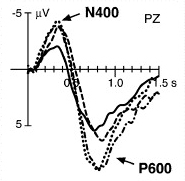 To explain a little, the researchers recorded EEG while participants read selections from Shakespeare. They were looking for EEG signatures of semantic violations (indexed by a negative voltage brain wave at ~400 msec, called the N400) and syntactic violations (indexed by a positive-voltage brain wave at ~600 msec, called the P600).
Above figure from a different study, published in Biological Psychology by Isel et al. (2006)
The brain waves were obtained by averaging a bunch of EEG trials together, and these event-related potential (ERP) components reflect summed electrical activity (post-synaptic potentials) from a huge number of pyramidal cells, recorded remotely from the scalp (to put it simply). The polarity of these components (i.e., positive or negative) does not indicate whether they are excitatory or inhibitory.
The stimulus materials were well-controlled for a number of factors. Some example sentences are given below.
Alternatives to the critical word are given between brackets. The functional shift is in bold, followed by the double violation condition (semantically incongruent and syntactically incorrect), followed by the semantic violation.I was not supposed to go there alone: you said you would accompany [companion / charcoal / incubate] me.They thought so well of the hero that they deified [godded / candled / printed] him.She was so beautiful that she spent her time displaying [windowing / hairing / posting] herself to everyone.Results indicated that the Shakespearean function shift elicited a P600 wave and another (earlier) component related to syntactic violation. However, the semantic N400 wave was not produced in response to these passages (Thierry et al., 2008):
This provides evidence that words which had their functional status changed triggered both an early syntactic evaluation process thought to be mainly automatic and a delayed re-evaluation/repair process that is more controlled, but semantic integration required no additional processing. We propose that this dissociation between syntactic and semantic evaluation enabled Shakespeare to create dramatic effects without diverting his public away from meaning.This work is part of a relatively large literature on ERPs, discourse processing, and sentence processing. Another very active area of investigation is fMRI studies of reading (over 1000 references in PubMed). But we don't learn about this in the NYT article. Nor do we get any actual fMRI results, just the outline of a proposed pilot study to look at theory of mind:
The team spent nearly a year figuring how one might test for [cognitive] complexity. What they came up with was mind reading — or how well an individual is able to track multiple sources. The pilot study, which he hopes will start later this spring, will involve 12 subjects. “Each will be put into the magnet” — an M.R.I. machine — “and given a set of texts of graduated complexity depending on the difficulty of source monitoring and we’ll watch what happens in the brain,” Mr. Holquist explained.Perhaps they're not familiar with earlier work on the neural correlates of metaphor comprehension (e.g., Yang et al., 2009) and irony comprehension (Rapp et al., 2010; Shibata et al., 2010). The metaphor experiment looked at processing difficulty, and the irony studies related comprehension to theory of mind abilities.
What can we learn from the impending crop of studies showing colorful pictures of "this is your brain on Virginia Woolf"?
"Let a man get up and say, Behold, this is the truth, and instantly I perceive a sandy cat filching a piece of fish in the background. Look, you have forgotten the cat, I say."-V. Woolf
Footnotes
1 Become a fan of Phoebe: ...But they don't know that we know they know we know! on Facebook.
2 Really? Don't they mean post-structuralism?
3 You wouldn't automatically turn to neuroscientists for insights on Shakespeare, would you?
References
Carhart-Harris R. & Friston K. (2010). The default-mode, ego-functions and free-energy: a neurobiological account of Freudian ideas. Brain Feb 28. [Epub ahead of print]
Rapp AM, Mutschler DE, Wild B, Erb M, Lengsfeld I, Saur R, Grodd W. (2010). Neural correlates of irony comprehension: the role of schizotypal personality traits. Brain Lang. 113:1-12.
Shibata M, Toyomura A, Itoh H, Abe J. (2010). Neural substrates of irony comprehension: A functional MRI study. Brain Res. 1308:114-23.
Thierry, G., Martin, C., Gonzalez-Diaz, V., Rezaie, R., Roberts, N., & Davis, P. (2008). Event-related potential characterisation of the Shakespearean functional shift in narrative sentence structure. NeuroImage, 40 (2), 923-931 DOI: 10.1016/j.neuroimage.2007.12.006
Tricomi E, Rangel A, Camerer CF, O'Doherty JP. (2010). Neural evidence for inequality-averse social preferences. Nature 463:1089-91.
Yang FG, Edens J, Simpson C, Krawczyk DC. (2009). Differences in task demands influence the hemispheric lateralization and neural correlates of metaphor. Brain Lang. 111:114-24.
NYT article via @jsnsndr


 Despite the heavy press coverage of smartphone operating systems like iPhone and Android, sometimes the most intriguing mobile innovations come from other companies. Case in point:
  There are four distinct mobile bots now available as